

Machine learning is one of the most exciting and fastest-growing fields in technology today. Whether you’re a developer, data analyst, or a curious enthusiast, knowing how to learn machine learning fast can set you apart in a competitive job market. This guide is designed to help you learn ML efficiently and effectively, without cutting corners on quality.
We’ll cover core strategies, resources, and mindsets to speed up your learning while aligning with best practices in the field.
Why Learn Machine Learning Fast?
With AI transforming industries like healthcare, finance, marketing, and more, learning ML is no longer optional for tech professionals—it’s a necessity. Here are a few compelling reasons to learn machine learning quickly:
- Career growth: Machine learning engineers and data scientists are among the highest-paid tech professionals.
- High demand: Companies are constantly looking for skilled ML practitioners.
- Innovation: ML opens doors to cutting-edge projects in AI, robotics, automation, and beyond.
- Versatility: Skills in ML can be applied to nearly any industry, from agriculture to automotive.
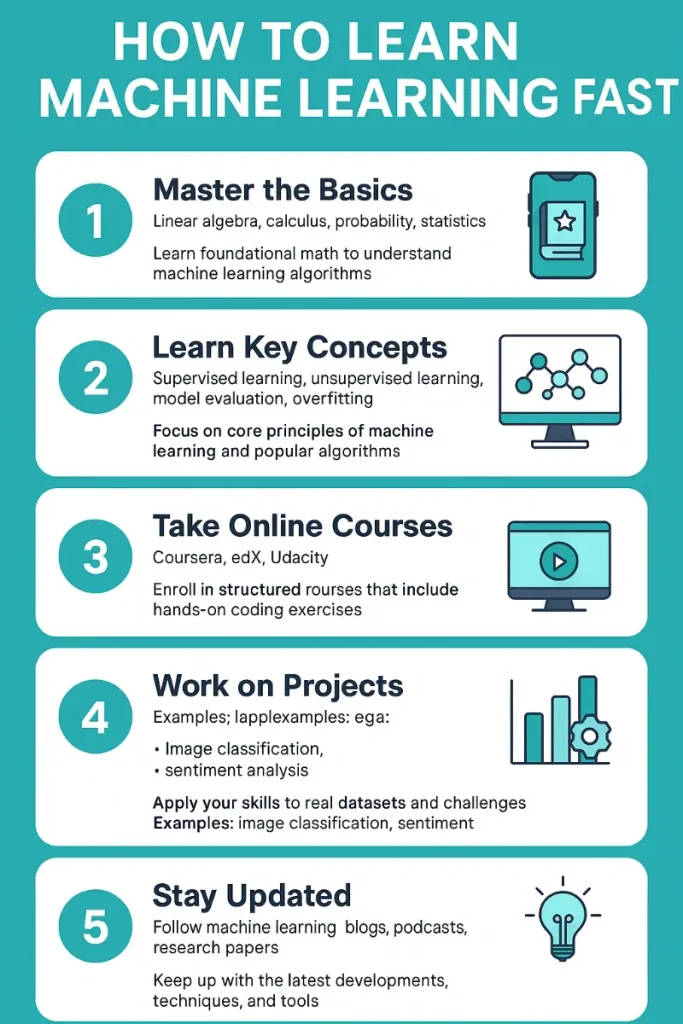
Step 1: Master the Prerequisites
Before jumping into ML models and algorithms, make sure you have a strong foundation in the following core areas.
1.1 Mathematics
Machine learning heavily relies on mathematical concepts:
- Linear Algebra: Learn about matrices, eigenvalues, and matrix decomposition. These are foundational for understanding how data is transformed and processed by algorithms.
- Probability & Statistics: Understand distributions, conditional probability, Bayes’ theorem, and statistical significance. These are essential for interpreting results and creating models that generalize well.
- Calculus: Focus on gradients and derivatives, which power optimization algorithms like gradient descent. Understanding partial derivatives will help in understanding backpropagation.
1.2 Programming
Python is the most popular language for ML:
- Start by mastering control flow, data structures, and basic syntax.
- Learn to work with libraries such as NumPy (numerical computations), Pandas (dataframes and analysis), and Matplotlib/Seaborn (for plotting data).
- Write code from scratch rather than relying on tutorials to deepen your understanding.
1.3 Data Handling
- Data cleaning involves handling missing data, removing duplicates, and dealing with incorrect data entries.
- Data transformation includes normalization, scaling, and encoding categorical variables.
- Develop the habit of visually exploring datasets to uncover hidden patterns.
Step 2: Follow a Structured Roadmap
Without a proper roadmap, it’s easy to get overwhelmed. Stick to the essentials first and then build complexity.
- Supervised Learning:
- Learn regression techniques (linear, ridge, lasso) to predict continuous outcomes.
- Study classification algorithms (logistic regression, decision trees, SVM, Naive Bayes) to categorize data.
- Focus on data splitting strategies and how to evaluate model performance.
- Unsupervised Learning:
- Understand clustering (K-Means, DBSCAN) for pattern recognition.
- Learn dimensionality reduction (PCA, t-SNE) for visualization and reducing noise.
- Model Evaluation:
- Beyond accuracy: Learn when to use metrics like precision, recall, F1-score, ROC-AUC, and confusion matrices.
- Dive into cross-validation methods like k-fold and stratified sampling.
- Feature Engineering:
- Experiment with different encoding techniques and transformation methods.
- Understand how to deal with feature interactions and correlation.
- Try tools like FeatureTools to automate feature engineering.
- Deep Learning Basics:
- Understand what neural networks are and how they differ from traditional ML algorithms.
- Learn about different architectures: feedforward networks, CNNs (for images), RNNs (for sequences).
- Practice building neural networks with Keras or PyTorch.
Step 3: Use High-Quality Learning Resources
You don’t need 50 courses. Just a few reliable ones will accelerate your progress.
- Courses:
- Andrew Ng’s Coursera ML course is great for fundamentals and intuition.
- DeepLearning.AI specialization teaches deep learning in a practical way.
- Fast.ai is fantastic for hands-on learners who want results quickly.
- Books:
- “Hands-On ML with Scikit-Learn, Keras, and TensorFlow” teaches both basics and advanced ML techniques.
- “Machine Learning Yearning” by Andrew Ng helps build practical ML thinking.
- Websites:
- Kaggle for projects, competitions, and community.
- Google’s ML Crash Course for structured learning with quizzes.
- Papers with Code to follow cutting-edge research along with implementations.
Step 4: Build Projects Early
Start coding as early as possible. Real-world application helps cement theory.
Beginner Projects
- Predict house prices based on square footage and location.
- Classify handwritten digits using logistic regression.
- Create a basic spam detection model using email text data.
Intermediate Projects
- Build a recommendation engine for movies using collaborative filtering.
- Analyze stock data and build predictive models using time-series methods.
- Use sentiment analysis to classify social media posts or product reviews.
Advanced Projects
- Image recognition with convolutional neural networks (CNNs).
- Language translation or chatbot using transformer models.
- Anomaly detection systems for fraud or cyber security.
Break your projects into stages: data collection, cleaning, exploration, modeling, evaluation, and deployment. This mirrors industry workflows.
Step 5: Join the ML Community
You’ll learn faster when you’re surrounded by people solving similar problems.
- Kaggle: Explore public notebooks and engage in discussions.
- GitHub: Contribute to open-source ML projects or share your own.
- LinkedIn & Twitter: Follow ML influencers and join relevant groups.
- Reddit & Discord: Communities like r/MachineLearning are full of insights and support.
Regularly sharing your progress and asking for feedback will help you grow faster.
Step 6: Learn to Debug and Optimize
When your model doesn’t perform well, you need to identify what’s going wrong.
- Overfitting: Learn to detect and fix this with regularization, dropout layers, or data augmentation.
- Underfitting: Tweak features or try more complex models.
- Learning curves: Plot them to visualize performance over training epochs.
- Tuning: Use hyperparameter optimization tools like GridSearchCV or Optuna.
Always monitor both training and validation performance. Good ML isn’t just about results—it’s about robustness.
Step 7: Stay Updated
The field of ML is evolving rapidly. To keep pace:
- Read weekly newsletters to catch major breakthroughs.
- Watch conference talks (NeurIPS, ICML, CVPR) on YouTube.
- Skim abstracts on arXiv to stay aware of new ideas.
- Engage in challenges on platforms like DrivenData and Zindi.
Staying current ensures you’re using the most efficient and accurate methods.
Bonus Tips to Learn Machine Learning Fast
- Daily Practice: Short, consistent study beats long, irregular sessions.
- Teach Others: Create YouTube videos or write blog posts.
- Micro Projects: Build quick models that solve simple problems.
- Set Deadlines: Create weekly sprints and goals.
- Join a Study Group: Accountability accelerates learning.
Common Pitfalls to Avoid
- Shiny Object Syndrome: Avoid hopping between courses and frameworks.
- Not Documenting: Keep notes on what you learn. Build your own knowledge base.
- Skipping Projects: You won’t master ML by watching videos alone.
- Ignoring Ethics: Learn about bias, fairness, and responsible AI practices.
Conclusion
Learning machine learning fast is absolutely possible with the right mindset, tools, and dedication. Build a strong foundation, follow a structured path, apply what you learn, and stay engaged with the community. Treat ML not as a subject to master overnight, but as a skill you improve daily.
With the right approach, you’ll be solving real-world problems and building impactful ML applications in no time.