

As the field of artificial intelligence continues to evolve, the concept of pretrained models in machine learning has become a foundational element in how modern AI systems are built. From chatbots to image classifiers, pretrained models are being used to accelerate development, improve performance, and reduce costs.
In this article, we explore the benefits of pretrained models in machine learning, their significance across various applications, and why leveraging them is a smart move for businesses, researchers, and developers alike. Whether you’re new to AI or an experienced practitioner, this guide will provide clear and comprehensive insights.
What Are Pretrained Models?
A pretrained model is a machine learning model that has already been trained on a large dataset and is made available for reuse. Instead of starting from scratch, developers use these models as a base and often fine-tune them for their specific tasks. These models have learned general patterns and representations from data, making them suitable for transfer to new but related tasks.
Pretrained models span multiple domains, including natural language processing (NLP), computer vision, and speech recognition. Examples include BERT for language understanding, ResNet for image classification, and GPT for text generation. These models have been trained on datasets like ImageNet, Wikipedia, and Common Crawl, allowing them to generalize well to a wide variety of inputs.
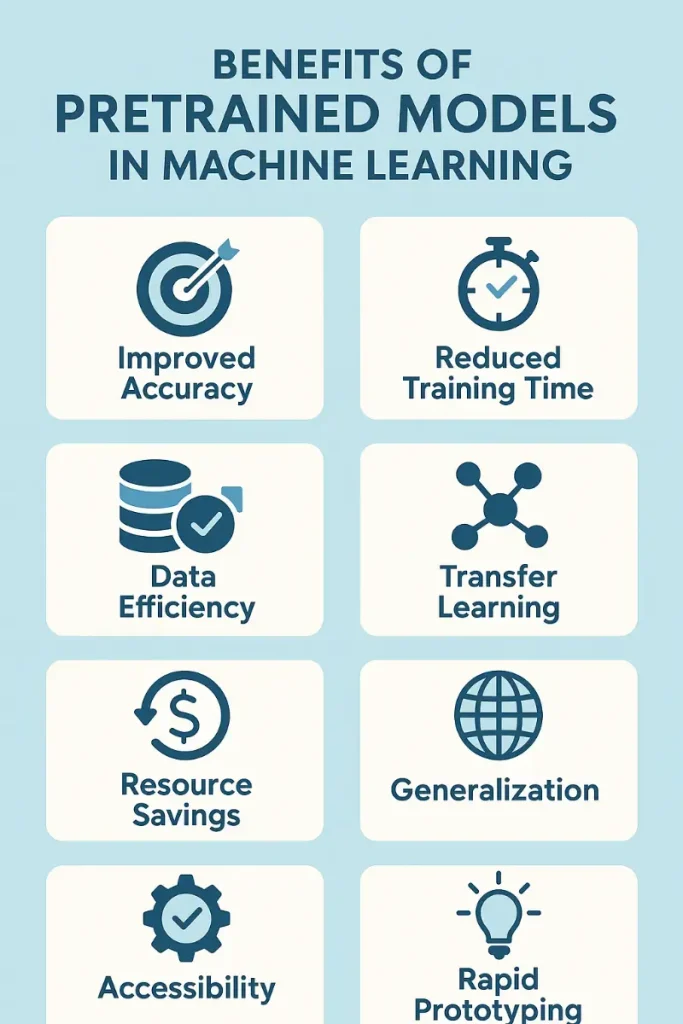
1. Saves Time and Resources
Training a machine learning model from scratch is time-consuming and computationally expensive. It requires extensive labeled datasets, high-performance hardware (such as GPUs or TPUs), and days or even weeks of training time. Beyond just training time, significant effort goes into data preprocessing, cleaning, augmentation, and pipeline setup.
Using pretrained models eliminates much of this burden. Developers can start with a model that has already learned general features and only needs to be fine-tuned on a small, task-specific dataset. This drastically reduces the time it takes to go from concept to deployment. For startups or research teams without access to large-scale infrastructure, pretrained models offer a way to build competitive AI solutions without the prohibitive cost of custom model training.
By skipping the early stages of model training, teams can focus on testing, iteration, and deployment. This leads to faster time-to-market and more efficient use of engineering resources.
2. Achieves Higher Accuracy with Less Data
Data scarcity is a common challenge in machine learning. Collecting and labeling high-quality data is often expensive and time-intensive, particularly in domains like medical imaging, legal analysis, or niche industries. Pretrained models help overcome this limitation by providing a model that already understands the underlying structure of the data.
Because these models have been exposed to millions or even billions of data points during pretraining, they already understand features like language syntax, image edges, textures, and object structures. Fine-tuning them on a small dataset allows them to adapt this knowledge to new contexts, often achieving impressive performance even when data is limited.
This benefit is particularly valuable in low-resource environments or when working with sensitive data that cannot be easily shared or expanded. Pretrained models enable high-performance AI with significantly reduced data requirements.
3. Enables Faster Experimentation and Prototyping
Machine learning development is often an iterative process. You try different model architectures, tweak hyperparameters, experiment with new data pipelines, and test various strategies for optimization. Pretrained models streamline this process by providing a solid starting point.
Instead of waiting days for training results, you can integrate a pretrained model into your pipeline and get feedback within hours. This ability to rapidly prototype different approaches empowers teams to iterate quickly, validate ideas faster, and fail forward with minimal risk. It also means you can deploy MVPs (Minimum Viable Products) in record time.
Fast experimentation is crucial for startups aiming to test ideas in the market, as well as for academic researchers working on tight deadlines or grant cycles. Pretrained models make it feasible to move from ideation to implementation much more efficiently.
4. Offers Standardization and Robust Community Support
Pretrained models developed and shared by leading research labs or open-source contributors often follow standardized architectures and best practices. Models like BERT, YOLO, and EfficientNet are built using proven engineering principles and are extensively benchmarked across popular datasets.
This standardization ensures reliability and ease of integration into existing ML workflows. Furthermore, because these models are widely used, there’s a large body of community-generated content surrounding them. You’ll find tutorials, GitHub repositories, forum threads, and Q&A discussions that help you troubleshoot issues or learn best practices.
Community support accelerates learning for beginners, reduces the knowledge gap, and improves adoption rates. It also means the models benefit from collective maintenance, bug fixes, and performance improvements, which individual teams might struggle to manage on their own.
5. Supports Better Generalization and Transfer Learning
Generalization—the ability of a model to perform well on unseen data—is a cornerstone of effective machine learning. Pretrained models tend to generalize better than models trained from scratch because they have already been exposed to a wide diversity of examples during pretraining.
This broad exposure equips the models with a set of generalized features that can be applied across tasks and domains. For example, a pretrained NLP model understands grammar, syntax, and semantics, while a vision model like ResNet understands textures, colors, and spatial relationships.
When you fine-tune a pretrained model on a new dataset, it doesn’t need to relearn basic concepts. Instead, it simply adjusts its knowledge to suit the specific characteristics of your task. This leads to more robust and reliable performance, especially in complex or unfamiliar scenarios.
Transfer learning—the process of adapting a pretrained model to a new problem—is made possible by this generalization capability. It allows businesses and researchers to apply existing knowledge to new challenges, often with minimal adjustments.
6. Democratizes Access to Advanced AI
Before pretrained models became widespread, building high-performing AI systems required significant expertise and computational resources. Today, even solo developers or small companies can incorporate cutting-edge AI into their products using pretrained models available through frameworks like Hugging Face, PyTorch, TensorFlow, and ONNX.
These frameworks offer simple APIs and libraries that make it easy to plug pretrained models into your application. Whether you need natural language understanding, speech recognition, or image segmentation, chances are there’s a pretrained model available for your use case.
This democratization levels the playing field, enabling innovation from a broader range of contributors. It also helps bridge the gap between research and production by making academic breakthroughs instantly accessible to developers and product teams.
Pretrained models lower the barrier to entry, empower non-experts, and allow companies across industries to benefit from AI without building it all from the ground up.
7. Encourages Environmentally Sustainable AI Practices
Training large-scale machine learning models requires enormous computational power, often resulting in a substantial carbon footprint. For instance, training a model like GPT-3 from scratch is estimated to emit several tons of CO₂ equivalent.
Using pretrained models alleviates this issue. Because the model has already been trained once and is being reused multiple times, the overall environmental cost per use case is significantly reduced. This form of model reuse supports the growing movement toward green AI.
Organizations can reduce their ecological impact while still accessing powerful AI tools by reusing pretrained models rather than duplicating expensive training efforts. This practice also aligns with sustainability goals and corporate responsibility initiatives.
As awareness of AI’s environmental impact increases, pretrained models will play a critical role in making AI development more energy-efficient and sustainable.
8. Easy Integration with Modern Frameworks and Pipelines
Today’s machine learning ecosystem is designed to accommodate pretrained models seamlessly. Libraries and frameworks such as Hugging Face Transformers, TensorFlow Hub, PyTorch Hub, and ONNX provide thousands of ready-to-use models.
These tools offer simple methods to load, customize, and deploy models across different platforms. Whether you are developing a mobile app, a web-based AI tool, or a server-side model deployment, you can easily integrate pretrained models into your existing stack.
This flexibility ensures faster deployment, easier maintenance, and reduced complexity in production environments. With ongoing updates, versioning, and compatibility features, pretrained model libraries make it easier than ever to build and scale AI solutions.
Conclusion
The benefits of pretrained models in machine learning are numerous and far-reaching. From saving time and resources to improving model accuracy and generalization, pretrained models offer a strategic advantage in the fast-paced world of AI development.
By providing a solid foundation of learned features and patterns, pretrained models empower developers to build smarter applications with less data, reduced cost, and shorter development cycles. They also promote environmental sustainability and broaden access to advanced AI technologies.
In an age where AI is transforming every industry, pretrained models serve as a bridge between cutting-edge research and real-world impact. Embracing them isn’t just convenient—it’s essential for anyone looking to innovate efficiently and responsibly in the machine learning space.