

Understanding how individuals make decisions is a cornerstone of research in psychology, neuroscience, and economics. The Drift Diffusion Model (DDM) is a widely used mathematical framework that describes the process of decision-making when choosing between two alternatives. By modeling the accumulation of evidence over time, the DDM helps researchers analyze both the accuracy of decisions and the reaction times associated with them.
This article delves into the Drift Diffusion Model, its components, mathematical formulation, applications, and limitations.
What is the Drift Diffusion Model?
The Drift Diffusion Model conceptualizes decision-making as a process in which information accumulates over time until a threshold is reached, triggering a decision. This model breaks the decision-making process into measurable components that explain both the outcome and the time taken to reach it.
Key Parameters of the Drift Diffusion Model
- Drift Rate (v):
- Represents the speed at which evidence accumulates toward a decision.
- A higher drift rate signifies clearer information or stronger evidence for one alternative.
- Boundary Separation (a):
- Reflects the amount of evidence required to make a decision.
- Wider boundaries correspond to cautious decision-making with longer reaction times but higher accuracy.
- Starting Point (z):
- Indicates bias toward one decision over another.
- A starting point closer to one boundary suggests a predisposition for that choice.
- Non-Decision Time (Ter):
- Accounts for the time spent on processes outside decision-making, such as sensory encoding or motor execution.
These parameters interact to provide a comprehensive framework for understanding decision-making behaviors.
Mathematical Formulation
The DDM is governed by a stochastic differential equation that models the accumulation of evidence over time:
\[dx(t) = v \, dt + s \, dW(t)\]Where:
- dx(t): Change in evidence at time t.
- v: Drift rate.
- dt: Infinitesimal time step.
- s: Noise standard deviation.
- dW(t): Wiener process representing random noise.
The process continues until the evidence x(t) reaches one of the predefined decision boundaries, leading to a decision.
Visualizing Evidence Accumulation
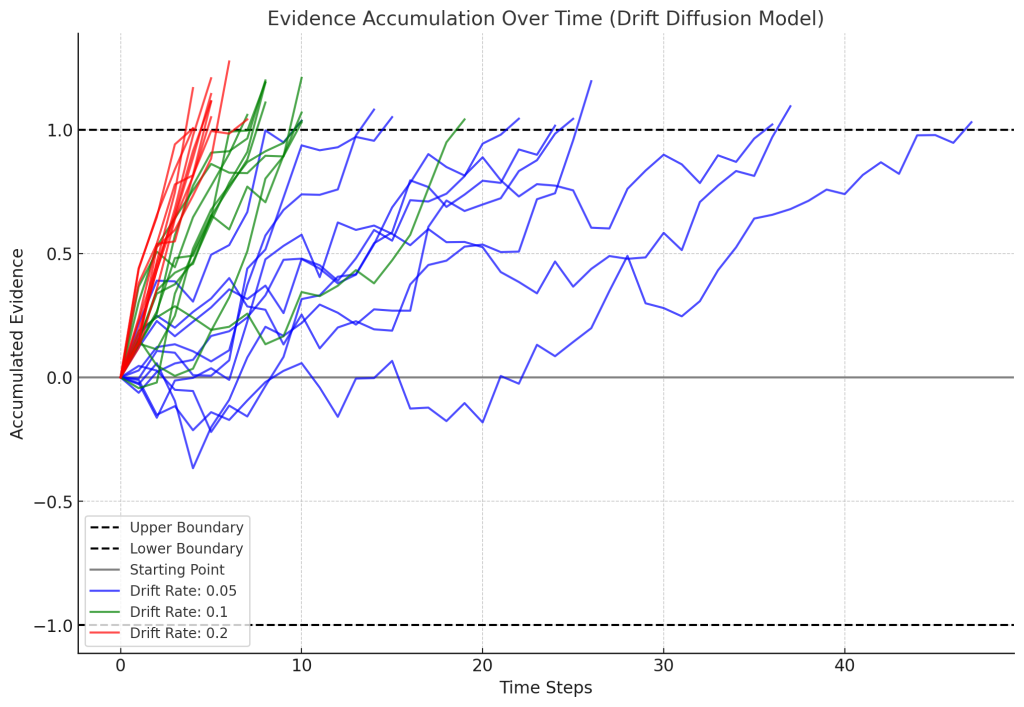
The graph below provides a clear representation of evidence accumulation over time in the Drift Diffusion Model. It highlights how different parameters, particularly the drift rate, influence decision-making processes. Let’s break down the key takeaways:
1. Role of Drift Rate
The graph features paths corresponding to three different drift rates:
- Low Drift Rate (Blue):
- Represents slower accumulation of evidence.
- Decisions take longer as the evidence accumulates gradually, resulting in extended reaction times.
- Increased variability in paths indicates a higher likelihood of errors due to noise dominating the accumulation process.
- Moderate Drift Rate (Green):
- Evidence accumulates at a balanced pace, leading to shorter reaction times and relatively higher decision accuracy.
- Variability in the paths is reduced compared to the low drift rate scenario.
- High Drift Rate (Red):
- Evidence quickly reaches a decision boundary, resulting in fast decisions.
- Steeper slopes indicate strong and consistent evidence favoring one choice.
- Reduced variability reflects greater decision accuracy.
2. Boundaries and Decision Points
The upper and lower boundaries represent the thresholds for making a decision. The graph shows that:
- Paths reaching the upper boundary correspond to one decision (e.g., “Choice A”).
- Paths hitting the lower boundary correspond to the alternative decision (e.g., “Choice B”).
The time it takes for paths to reach a boundary reflects the reaction time, which is influenced by drift rate and noise.
3. Impact of Noise
The randomness in each path simulates noise in the decision-making process. Noise introduces variability in how quickly or accurately decisions are made.
- Higher noise levels can lead to slower decisions or errors, as seen in paths deviating widely before reaching a boundary.
- Lower noise ensures more consistent paths and faster convergence to a decision.
4. Insights for Real-World Applications
This visualization demonstrates how the Drift Diffusion Model captures variability in human decision-making. For example:
- In psychology, it explains why certain individuals may take longer to respond in decision tasks, especially under low drift rate conditions.
- In neuroscience, it links observed variability in neural signals to reaction times and decision accuracy.
- In marketing or economics, it can model consumer decision-making, where low drift rates reflect indecision or ambiguity in choices.
This graph effectively shows how DDM parameters like drift rate and noise interact to shape decision dynamics, making the abstract concepts more tangible and accessible for analysis and application.
Comparison with Other Decision-Making Models
The Drift Diffusion Model (DDM) is a robust framework for understanding decision-making, but it is not the only model used to study how individuals make choices. Alternative models, such as Race Models and Bayesian Models, offer different approaches to explaining decision dynamics. This section compares these models, highlighting their strengths and weaknesses and their applicability in various scenarios.
1. Race Models
Race Models are another class of decision-making models where multiple accumulators independently collect evidence for each option. Unlike the DDM, which uses a single accumulator with thresholds for two choices, Race Models feature separate accumulators for each choice.
Key Features:
- Each accumulator gathers evidence for its corresponding option.
- The decision is made when the evidence in one accumulator first reaches its threshold.
Strengths of Race Models:
- Multi-Choice Scenarios: Unlike the DDM, which is inherently binary, Race Models naturally extend to decisions involving more than two alternatives.
- Parallel Evidence Accumulation: By modeling each option independently, Race Models provide a detailed view of how evidence for each choice evolves over time.
Weaknesses of Race Models:
- Noisy Dependencies: Since accumulators are independent, Race Models may not account for competitive dynamics between choices, which are often observed in real-world decisions.
- Less Flexible for Single Choices: In binary scenarios, the DDM often provides a more parsimonious explanation with fewer parameters.
Applications:
Race Models are particularly useful in tasks with multiple distinct alternatives, such as predicting consumer preferences among a set of products or modeling real-time strategy game decisions.
2. Bayesian Models
Bayesian Models take a probabilistic approach to decision-making, focusing on how individuals update their beliefs about the likelihood of different outcomes based on observed evidence. Decisions are made by selecting the option with the highest posterior probability.
Key Features:
- Incorporates prior knowledge and observed evidence to calculate posterior probabilities.
- Decisions are modeled as a process of belief updating rather than evidence accumulation.
Strengths of Bayesian Models:
- Integration of Prior Knowledge: Bayesian Models excel in situations where prior probabilities play a significant role, such as medical diagnoses or financial forecasting.
- Flexible Decision Rules: These models adapt well to tasks where decision thresholds or probabilities vary dynamically.
Weaknesses of Bayesian Models:
- Computational Complexity: Bayesian inference often requires significant computational resources, especially for complex or real-time applications.
- Lack of Temporal Dynamics: Unlike DDM, Bayesian Models do not inherently capture the temporal process of decision-making, such as reaction times.
Applications:
Bayesian Models are widely used in fields where probabilistic reasoning is critical, such as AI, robotics, and cognitive neuroscience. For example, they model how individuals make decisions under uncertainty or integrate sensory information to form judgments.
3. Strengths and Weaknesses of the DDM Compared to Alternatives
Strengths of the DDM:
- Temporal Dynamics: The DDM excels in explaining both decision outcomes and reaction times, making it ideal for tasks involving timed decisions.
- Simplicity: With relatively few parameters, the DDM provides a parsimonious explanation for binary decision-making.
- Behavioral Predictions: It effectively predicts decision accuracy and variability across trials.
Weaknesses of the DDM:
- Binary Limitation: The standard DDM is restricted to two-choice scenarios, making it less applicable for tasks with multiple alternatives.
- No Priors: The DDM does not account for prior probabilities, which are central to Bayesian reasoning.
Summary of Comparison
| Feature | Drift Diffusion Model | Race Models | Bayesian Models |
|---|---|---|---|
| Core Mechanism | Evidence accumulation | Parallel accumulators | Belief updating |
| Multi-Choice Scenarios | Limited to two choices | Naturally supports multi-choice | Supports multi-choice |
| Reaction Times | Explicitly modeled | Explicitly modeled | Not explicitly modeled |
| Incorporates Priors | No | No | Yes |
| Applications | Psychology, neuroscience | Consumer behavior, strategy | Probabilistic reasoning, AI |
This comparison illustrates that while the DDM is highly effective for binary decision-making tasks, Race Models and Bayesian Models offer advantages in specific contexts, such as multi-choice decisions and probabilistic reasoning. Selecting the appropriate model depends on the task requirements and the nature of the decision-making process being studied.
Applications of the Drift Diffusion Model
The Drift Diffusion Model (DDM) has versatile applications across multiple fields. Below are its key uses:
- Psychology:
- Used to understand cognitive processes in simple decision-making tasks, such as distinguishing between stimuli.
- Explains how task difficulty and attention influence decision accuracy and reaction times.
- Neuroscience:
- Links DDM parameters, such as drift rate, to neural activity in the brain.
- Provides insights into brain mechanisms underlying decision-making processes.
- Economics:
- Models consumer behavior and financial decision-making under uncertainty.
- Helps predict how people choose between competing products or investment options.
- Clinical Research:
- Assesses decision-making impairments in individuals with neurological or psychiatric conditions, such as ADHD or schizophrenia.
- Provides a framework for understanding deficits and tailoring interventions.
Advantages of the Drift Diffusion Model
The DDM is favored for several reasons:
- Simplicity and Parsimony:
- Provides a straightforward yet powerful explanation of decision-making processes.
- Predictive Accuracy:
- Captures both choice probabilities and reaction time distributions effectively.
- Parameter Interpretability:
- Each parameter corresponds to specific cognitive processes, making the model results highly interpretable.
- Broad Applicability:
- Can be applied across disciplines, from psychology to marketing.
Limitations of the Drift Diffusion Model
Despite its strengths, the DDM has some limitations:
- Binary Decisions Only:
- The model assumes a two-choice decision-making framework, which limits its applicability to multi-alternative scenarios.
- Simplified Cognitive Dynamics:
- It doesn’t account for more complex cognitive processes, such as learning, memory, or emotional influences.
- Parameter Estimation Complexity:
- Accurately estimating parameters requires advanced statistical techniques and can be computationally intensive.
- Assumption of Constant Parameters:
- Assumes that drift rate and boundaries remain constant, which might not reflect real-world variability.
Future Directions in Drift Diffusion Modeling
As research advances, several enhancements to the DDM are emerging:
- Multi-Alternative Models: Extensions of the DDM are being developed to handle decisions involving more than two options.
- Incorporating Learning and Memory: Models integrating adaptive drift rates based on prior experiences are gaining traction.
- Neurocomputational Integration: Bridging the gap between DDM parameters and neural signals is a growing area of study, helping to link behavior with brain activity.
Conclusion
The Drift Diffusion Model is a cornerstone of decision-making research, providing a robust framework to analyze the dynamics of choice and reaction times. Its ability to link behavioral data with underlying cognitive processes makes it an indispensable tool across fields such as psychology, neuroscience, and economics.
While the model has limitations, ongoing advancements in computational techniques and neurocognitive research continue to expand its scope. For researchers, practitioners, and decision analysts, the DDM offers a powerful lens through which to understand and predict decision-making behaviors.