

Collaborative filtering is a fundamental technique used in recommendation systems to predict user preferences. By leveraging user interactions and data, it provides personalized recommendations that can significantly enhance user experiences on platforms like Netflix, Amazon, and Spotify. This guide covers everything you need to know about collaborative filtering, including its types, applications, challenges, and implementation methods.
What is Collaborative Filtering?
Collaborative filtering is a recommendation technique that predicts a user’s preferences by analyzing their interactions with various items and comparing them to those of other users. The core idea is simple: if users have agreed on certain preferences in the past, they are likely to agree again in the future. For example, if two users have similar tastes in movies, a recommendation system can suggest films that one user liked to the other.
This technique is used in various industries, including streaming services, e-commerce, and social media, making it an essential tool for businesses looking to improve user engagement.
How Does Collaborative Filtering Work?
At its core, collaborative filtering operates using a user-item matrix, where rows represent users, and columns represent items (like movies, products, or songs). The matrix captures the interactions (e.g., ratings, purchases, or clicks) between users and items. Collaborative filtering uses this matrix to identify patterns and similarities between users or items.
Types of Collaborative Filtering
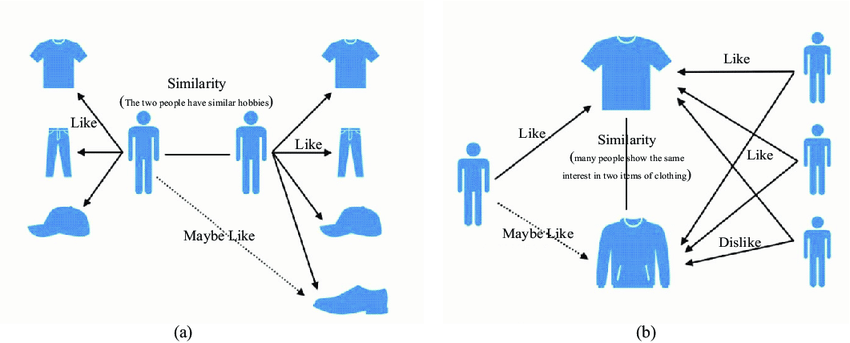
Collaborative filtering can be broadly categorized into two main types: User-User Collaborative Filtering and Item-Item Collaborative Filtering.
User-User Collaborative Filtering
User-user collaborative filtering, also known as user-based filtering, identifies users who have similar preferences or behaviors. The system then recommends items that similar users have liked.
Example: If user A and user B both liked the same movies, and user A liked a new movie that user B hasn’t seen yet, the system might recommend that movie to user B.
Pros:
- Personalized Recommendations: User-based filtering is highly personalized as it takes into account individual preferences.
- Ease of Explanation: It is easy to explain recommendations to users by saying, “We recommended this because people similar to you liked it.”
Cons:
- Data Sparsity: It requires a large amount of user data to identify similarities, which can be challenging when user interactions are limited.
- Scalability: Finding similar users becomes computationally intensive as the number of users grows.
Item-Item Collaborative Filtering
Item-item collaborative filtering, or item-based filtering, measures the similarity between items based on the preferences of users. The system recommends items similar to those that the user has already liked or interacted with.
Example: If a user has rated a particular movie highly, item-based filtering might recommend other movies that users who liked that movie also rated highly.
Pros:
- Better with Sparse Data: Item-item methods are more efficient when the user-item matrix is sparse, making them suitable for large datasets.
- Stability Over Time: Recommendations are less likely to change drastically since items tend to remain consistent in their ratings.
Cons:
- Cold Start Problem: New items with little interaction data can be challenging to recommend accurately.
- Limited Novelty: Recommendations may become predictable, as they often suggest items similar to those the user has already experienced.
Model-Based Collaborative Filtering
In addition to memory-based approaches like user-user and item-item filtering, model-based collaborative filtering uses machine learning algorithms to predict user preferences. These models, such as matrix factorization or neural networks, create latent representations of users and items to make more accurate predictions.
Matrix Factorization: This technique breaks down the user-item interaction matrix into lower-dimensional matrices, capturing the latent features of users and items. It is especially useful for addressing data sparsity by reducing the complexity of the data and finding hidden patterns.
Example: In a movie recommendation system, matrix factorization might capture latent factors such as genre preferences or viewing patterns, making it easier to recommend movies that align with a user’s hidden interests.
Challenges in Collaborative Filtering
While collaborative filtering offers powerful personalization, it faces several challenges:
- Cold Start Problem: When a new user or item is added to the system, it lacks the interaction data needed to make accurate recommendations. Solutions often include incorporating hybrid methods with content-based filtering or asking users for initial preferences.
- Data Sparsity: Most recommendation systems deal with large but sparse user-item matrices, where users interact with only a small subset of items. This can lead to challenges in identifying meaningful patterns. Using techniques like matrix factorization or dimensionality reduction can help address this issue.
- Scalability: As the number of users and items grows, the computation required to find similarities increases, making it difficult to scale the system efficiently. Model-based approaches or approximate nearest neighbors algorithms can help improve scalability.
Implementing Collaborative Filtering in Python
Here’s a simple example of implementing user-user collaborative filtering using cosine similarity in Python:
from sklearn.metrics.pairwise import cosine_similarity
import pandas as pd

# Example user-item ratings matrix
data = {
    'User1': [5, 3, 0, 1],
    'User2': [4, 0, 0, 1],
    'User3': [1, 1, 0, 5],
    'User4': [1, 0, 4, 4],
    'User5': [0, 1, 5, 4],
}
df = pd.DataFrame(data, index=['Item1', 'Item2', 'Item3', 'Item4'])

# Calculate cosine similarity between users
similarity_matrix = cosine_similarity(df.T)
similarity_df = pd.DataFrame(similarity_matrix, index=data.keys(), columns=data.keys())
print(similarity_df)
The output is a similarity matrix that helps identify users with similar preferences, making it easier to recommend new items based on user similarities.
Applications of Collaborative Filtering
- E-commerce: Platforms like Amazon use collaborative filtering to recommend products based on user purchase history and the behavior of similar users.
- Streaming Services: Netflix and Spotify leverage collaborative filtering to suggest movies or music that align with users’ tastes.
- Social Media: Platforms like YouTube use this method to recommend videos based on user viewing habits and similar users’ preferences.
Conclusion
Collaborative filtering is a cornerstone of modern recommendation systems, offering personalized suggestions by leveraging user behavior and interaction data. Whether using user-user, item-item, or model-based methods, collaborative filtering can transform user experiences and drive engagement. Understanding its strengths, challenges, and applications allows businesses to deploy more effective recommendation systems and stay competitive in a data-driven world. By mastering collaborative filtering techniques, you can build systems that make accurate and relevant recommendations, keeping users engaged and satisfied.